Wednesday, March 14, 2007

What Credit Card Companies Don't Want You to Know

I just read an article that I had to share with the Romine Faithful. Wow, talk about a powerful clause that could really hurt you!

Here it is...


What Credit Card Companies Don't Want You to Know

by David Bach

Of all the games the credit card companies play that end up costing you thousands of dollars (late fees, over-limit fees, transfer fees, and so on), it's always been the interest rate game that hurt the most -- until now.

There's a new, completely legal game they're playing, and it can literally wipe you out financially if you're not careful.

The Universal Default Clause

If you own a credit card, you know by now that if you're late with a payment the credit card company will charge you a late fee in addition to raising your interest rate. But did you know that they can raise your interest rate if you've made a late payment on any of your other cards, including those issued by other companies?

Not only that, but your interest rates can skyrocket to 30 percent or more if you make a late payment on your car loan, mortgage, or even your phone bill!

"How can that be legal?" you may ask. The answer is found in the fine print of your credit card agreement, and it's called a universal default clause. According to the Institute of Consumer Financial Education, currently almost 40 percent of credit card issuers apply this policy to their customers.

A Late Payment 'Trigger'

Generally, a universal default clause states that a creditor reserves the right to penalize you with an increased interest rate if you're late -- that is, in default -- of a payment to any other creditor. They justify this practice because, in theory, if you pay any of your creditors late, you pose a greater credit risk and are less likely to pay your debt.

Your creditors also have the right to routinely monitor your credit file. So a creditor with a universal default clause will be watching -- and waiting.

Let's say your Visa card has a universal default clause. Any late payment -- whether it's on your utility bill, home equity loan, or Macy's credit card -- acts as a "default trigger" allowing the bank that issued the Visa card to double or even triple your interest rate overnight. Your all-important credit score will be hurt as well.

According to a study by the nonprofit advocacy and education group Consumer Action, the top three default triggers that cause your interest rates to spike are a decline in credit score, paying your mortgage late, and paying your car loan late.

Other Triggers to Worry About

Under the universal default clause, your interest rates can be increased for several other reasons, including exceeding your credit limit, bouncing a check, having too much debt, having too much credit, getting a new credit card, applying for a car loan, and applying for a mortgage loan.

How does this affect your financial future? Take a look at the numbers. Let's say you're an average American household, with $8,000 of credit card debt. Assuming you make no additional purchases on your card, you have a 9 percent interest rate, and you make the minimum monthly payment, it'll take you 218 months (18 years) to pay off your debt and you'll end up paying $3,334 in interest.

Now let's assume that for whatever reason you were late one month with your car payment. This late payment triggers the universal default clause with your credit card issuer, and now your penalty rate gets increased to 24 percent (the average default rate in 2005). It'll now take you 679 months (56 years) to pay off your credit card debt, and get this -- you'll pay $30,813 in interest.

Staying Ahead of the Clause

Here are six ways to protect yourself from interest rate hike triggers:

1. Stay away from credit cards with a universal default clause.

If you're looking to open a new credit card account, be sure to choose one without a universal default clause. This means you have to truly read the fine print. If you're confused by the fine print (as many are), call the credit card company and ask what specific circumstances will affect your interest rate.

I read recently that Capital One cards don't have a universal default clause (although you should double-check before applying), and Citi has dropped its universal default policy as well. In addition, sites like CardWeb.com, Bankrate.com, and LowerMyBills.com let you compare credit card offers, so visit them before you apply.

2. Know your current obligations.

Check your current statements and credit card agreements to find out your current interest rates, and to identify which cards have a universal default clause that you weren't aware of until now. Again, if you're uncertain after reading the fine print, call your credit card company.

Consider transferring your balance from a card that has the universal default clause to one of your cards that doesn't. But don't rush to cancel the card altogether, because it could have a negative effect on your credit score.

3. Run your credit report.

Not only do you need to know exactly what your current interest rates are, you also need to know exactly what's on your credit report. Visit Freecreditreport.com or myFICO to order your credit report and credit score today.

4. Pay your bills on time.

According to the American Bankers Association, late payments for most types of consumer loans were on the rise during the third quarter of 2006. If you're having trouble with your credit card payments, at the very least strive to make your minimum payment on time.

5. Be proactive -- call your lender for relief.

If you're struggling to make monthly payments on your other bills, like utilities, car payments, or mortgage payments, call your lender to see what options they might be able to offer you. They might be able to adjust your monthly payments so that they're more manageable.

Your goal is to protect your credit report and credit score with a consistent record of on-time payments.

6. Fight back for your money -- write your local legislator.

Right now, there are amendments to the Truth in Lending Act that, if passed, would prohibit many unfair practices within the credit card industry -- including the universal default clause.

As a consumer, you can take action by letting Congress know that you want laws to protect your rights. For more information on how you can be heard, visit Consumer Action's web site.

As I write this, Congress is holding hearings to discuss the abusive and deceptive practices of the credit card industry. Read more about it here.

A Good Night's Sleep

Obviously, what you don't know really can hurt you. Check today and see if you have the universal default clause on your credit cards.

If you do, be careful to stay on top of your debt. Better yet, find a credit card that doesn't have the clause -- you'll sleep better at night.


Now go buy a house!

Gerald Romine
www.KickAssRealEstate.com

PS - It's much better to learn how to buy wholesale using the greatest flipping system for real estate than to get yourself into financial trouble by spending money you don't have.

Tuesday, March 6, 2007

Killer News For Real Estate Investors

Last Friday marked a huge turning day for real estate investors nationwide and is very bad news for first time home buyers, real estate agents, investors(yes, even us because we sell to other investors) builders, loan officers, and just about everyone in the residential real estate and mortgage business.

What Happened That Rocked The Real Estate Industry?

Foreclosure rates have been climbing and the valuations of lenders and especially secondary lenders has taken a beating. Many of the companies specializing in 100% sub prime loans that have been extremely popular over the last 5 plus years are struggling with many going out of business.

And when you build your business on shaky ground with buyers that can’t qualify for squat it is only a matter of time before that house of cards comes tumbling down. So it is no surprise that the lending world is changing by leaps and bounds.

In plain English this means we’re back to buyers having to qualify for houses but not having the resources like 100% down financing to buy them.

We’re talking about buyers needing to have much better credit scores and much better down payments.

Combine that with the weak market and foreclosure boom and you have The Perfect Real Estate Buying Bonanza waiting to happen!

To Capitalize On This Bonanza You Must Have These Techniques In Your Arsenal Right Now!

1) Wholesaling and Subject To Buying
2) Short Sales on Pre Foreclosures


If you are not utilizing these systems you are losing money! If you make one mistake you run the risk of not only making somebody else’s problem your own but losing a lot of greenbacks. Dough you could have kept had you only known.

For wholesaling and buying subject to I conducted a boot camp that was recorded live and is available for you to take advantage of if you are wise and want to take advantage of the coming Perfect Buying Bonanza.

The truth is these CD’s are unedited and raw. Every question, every suggestion, every single reason on what to do and how to do it is covered in detail. All the forms you need, it’s all there waiting for you.

My guess is that your business is sliding backward and you are giving up huge profits and opportunities. Here’s where to go to learn wholesale buying and subject to.

The second part of the Perfect Buying Bonanza is in full swing right now. Preforeclosures and short sales are hot and getting hotter. Upside down houses are everywhere. People are going under and the opportunity to short houses has never been higher. My system completely automates the short sale process and working with the lender to get deals accepted. Period. Either you see the need to have this system or you don’t. It’s so obvious I won’t even go on.

With the information I provide you will have all of the tools you need to jump in the middle of this storm and Kick Your Business Into High Gear Like Never Before!

Now go buy a house!

Gerald Romine
www.KickAssRealEstate.com

PS - It's time to GET IN the real estate game in a big way!

Monday, February 26, 2007

Top 10 Tax Deductions For Real Estate Investors

Today I’m going to reveal the top 10 tax deductions for real estate investors!

Now that the markets have changed many of the flippers and wholesale guys are finding tough times in the market. Before one could put any property under contract then sell it quickly for huge profits. Now the real investors are back and buying with better spreads. Sure, there are plenty of new investors out there buying foolishly, but not in the masses like before.
True investing invloves holding real estate and building wealth. If all you ever do is flip properties then you are only as good as your next deal. Think about it!


Top 10 Tax Deductions For Real Estate Investors

1. Interest
Interest is often the largest deductible for property owners. Examples include.

Mortgage interest payments on your loans for acquiring or improving rental property
Interest on credit cards for goods and services purchased for rental activity

2. Depreciation
Depending on whether you have residential or commercial property, the value of your rental property can be depreciated over a number of years and deducted from the total taxable income. Residential property is depreciated over 27.5 years.

3. Insurance
Insurance premium payments are also a deduction; including fire, theft, flood, landlord liability and employee's health/worker's compensation policies.

4. Employees/Independent Contractors
Wages for any work done on the property by your employees (property manager) or independent contractors (plumber) can be deducted as a business expense.

5. Repairs
Some repair expenses are deductible (if they are deemed ordinary, necessary and within reason) if they are incurred during the tax year you are filing for.

6. Home Office
You can deduct home office expenses provided they meet certain minimal requirements. This deduction applies to space used for office work as well as other workspaces you use to operate your rental business.

7. Local Travel
You are entitled to a tax deduction on the expenses you incur while traveling for work related to your rental activity. Traveling expenses that are related to rental activity may include driving to a property to show a unit to a prospective tenant or driving to a hardware store to pick up supplies for a maintenance task.

8. Long Distance Travel
Airfare, lodging, meals and other expenses can be deductions if you travel overnight.

9. Casualty & Theft Loss
Rental property that is damaged or destroyed by a sudden accident (such as flood or fire) may be counted as a tax deduction as well. All or part of the damage (casualty loss) may be deducted depending on how much of the property was damaged and your insurance policy.

10. Legal & Professional Services

Fees paid to accountants, attorneys, property management firms, bankers/investment advisors, or any other professional service used to operate your rental property can also be included in your deductions.


Goto www.kickasswholesaling.com to learn how to buy properties the right way. Whether you are flippingproperties, buying subject to or building a portfolio you make money when you buy. This is your ultimate real estate buying system. Now go buy a house!

Gerald Romine
www.KickAssRealEstate.com

Friday, February 23, 2007

The 7 Secrets To Keep You Buying Right In Today's Changing Market

When evaluating property first determine the ARV(After Repaired Value).

Here are 7 Secrets to keep real estate investors buying right:

1) Use comps that are less than 6 months old
2) Keep the square footage within 10%.
3) Keep the year built to within 5 years
4) Be on the lookout for falling values
5) Check MLS – Properties currently listed could be offered at less than yesterday’s sold statistics
6) Location – If a SFR house fronts a busy street or is close to a large commercial property/apartment/etc deduct 10% of it’s value
7) Compare to properties in the same subdivision is possible. After that book/map or a radius of .5 mile is best.

Gerald Rominewww.KickAssRealEstate.com

PS – The secret to real estate investing success lies in the system you use to buy properties right. Check out the best buying system in existence today because once you put it in place you’ll never imagine your life without it again.

Friday, February 9, 2007

The Computer Is A Real Estate Investors Best Friend

These days real estate investors spend a lot of time on the computer. Websites, MLS, comp research, tax offices, and the list goes on. I’m an impatient guy and my computer was dragging along so I needed to do some good old computer maintenance.

Check out http://www.techsupportalert.com/best_46_free_utilities.htm and if your computer is running slow consider #26 to clean your registry. And if you don’t know what I’m talking about you definitely need #26. There’s a lot more there plus Gizmo gives awesome descriptions.

Happy Investing.

Gerald Romine

PS – And when you need speed with your real estate analysis and paperwork Real Estate Profit Pro makes it a breeze!

Friday, February 2, 2007

Why You Should Always Invest Based On The Numbers

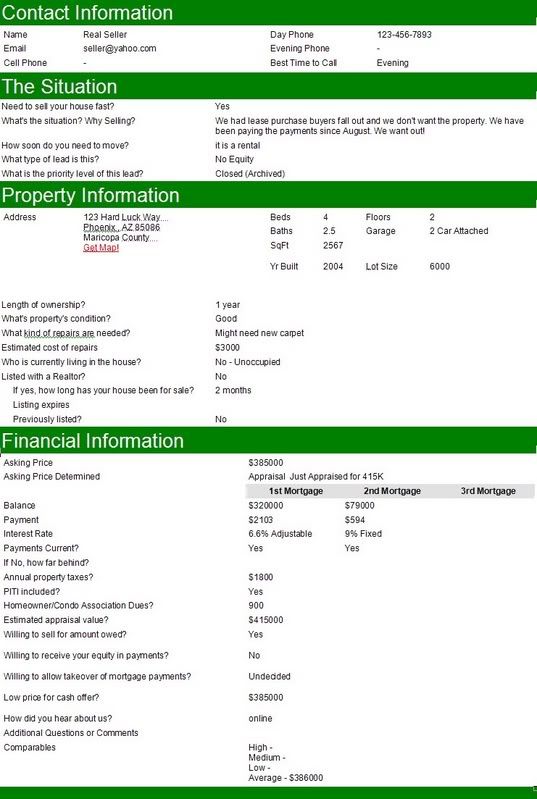
I received a call from a seller that desperately wanted to sell her investment house . This deal illustrates a great point of why you want to invest in the numbers based on a system like Kick Ass Wholesaling (which covers buying for cash and subject to).

Last January she bought the house for 400K and it included a tenant with PREPAID rent and an Option to buy the property. With great appreciation expected to continue she was not too worried about the negative cash flow even though her payments were over $2700 per month. Plus, she was getting prepaid rent at the closing when she bought the property!

Shortly after closing the tenant moved out. Because of the prepaid rent and option all she could do was wait for the lease and option to expire. In the meantime the tenant moved in and out of the house several times. Her hands were tied. In the meantime the market tanked.

Fast forward to today and the house just appraised for 415K... unfortunatelythe appraisal is worthless because the average sale price is 386K in the subdivision. Market value for leasing the property is under 1500 per month. She has great credit that she wants to protect. Her options are few.

Below is the actual lead sheet I received for your review(double click lead sheet to view a readable copy).


Today’s lesson is… invest based on today's numbers and not the future values and appreciation.


This seller has very few options but if she had followed fundamental investing like those in http://www.kickasswholesaling.com/ she would have never purchased this property. As it sits she can expect at least a 50K loss, trashed credit, or carrying the negative cash flow until appreciation covers her poor investing decision.

Hopefully you can learn from her mistakes.

Now go buy a house!

Gerald Romine

Tuesday, January 16, 2007

HowTo Get More Done In Less Time To Grow Your Real Estate Investing Business

l. Instead of rushing to the office first thing in the morning, keep your computer off and visit your local Starbucks(I drink tea) or living room and spend time working ON your business. Keeping your computer off will help you get non-computer things done (ex. Studying, reading, market analysis, etc).

2. Stop working at a specific time each day and go somewhere where you'll be undisturbed. It is important to take time off from work everyday. My time where I recharge is in the gym with my workout partner. The exercise is great but we both enjoy being able to shut down our brain and ‘turn off’ the work mode.

3. Stop checking your email every 15 minutes. You’ll make more money checking it two times a day on a schedule then you will wasting hours to see what junk has just arrived. I use Outlook and changed the setting to OFFLINE which allows me to send/receive mail only when I tell outlook to do so. Before doing this I was distracted every time an email came in and flashed on my screen.

The best way to accomplish your goals and IMPORTANT TASKS is to make the decision that you're going to work on your business each and everyday and then schedule that time and keep your commitment to the schedule.

Now go buy a house!

Gerald Romine
www.KickAssRealEstate.com